

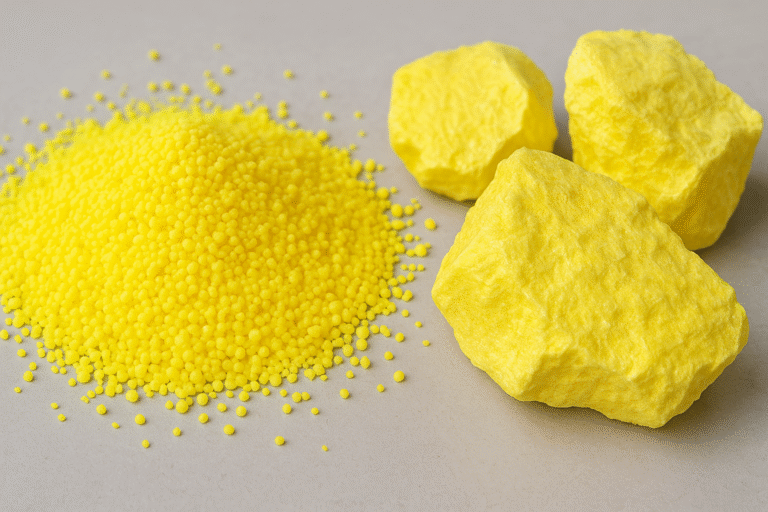
Sulfur (also spelled sulphur in British and Australian English) remains one of the most strategically important industrial raw materials in the global economy. While often discussed as a commodity input, its true value lies in its central role in fertiliser production, industrial manufacturing, and environmental compliance within the energy and refining sectors. For buyers seeking consistent quality and reliable logistics, a clear understanding of sulfur’s end-use profile and specification parameters is essential.
Global sulfur supply is derived from two principal streams:
In modern markets, direct mining of elemental sulfur is a relatively small share of global supply compared with recovered production.
It is important to distinguish mined sulfur from overall sulfur production. Many countries produce large volumes of sulfur primarily because of refining and gas processing capacity, meaning most output is recovered rather than mined.
Sulfur’s commercial significance is best understood through its relationship with sulfuric acid, being one of the world’s most widely used industrial chemicals. Sulfuric acid underpins phosphate fertiliser manufacturing, metal processing, and numerous downstream chemical industries. As a result, sulfur demand is closely tied to agricultural expansion and industrial growth in both emerging and established markets.
Sulfur is an essential plant nutrient, particularly in protein synthesis and enzyme function. Modern intensive cultivation can deplete soil sulfur over time. Sulfur is commonly used:
Granular sulfur is often preferred for blending and downstream processing due to its handling efficiency and suitability for large-scale distribution.
Industrial demand extends well beyond agriculture. Sulfur is used directly or indirectly in:
This diversity of end uses supports stable baseline demand, even when agricultural cycles fluctuate.
Globally mandated fuel sulfur limits require refineries to remove sulfur from petroleum products and treat sour gas streams. The recovered sulfur then enters industrial and agricultural supply channels. For buyers, this reinforces the importance of supply chain visibility and long-term offtake relationships, especially in higher-spec markets requiring tighter impurity controls.
For most commercial applications, particularly sulfuric acid production and fertiliser manufacturing, buyers should pay close attention to:
Where supply is intended for higher-value industrial conversion, specification alignment should be confirmed against process tolerances and incorporated into the sales contract.
Sulfur is commonly supplied in granular or lump form, shipped as:
Storage should be dry, well-ventilated, and protected from contamination. Although sulfur is stable as a commodity, fine particulate dust can present combustion risk under certain conditions. Handling protocols should therefore align with recognised safety standards.
In sulfur procurement, risk allocation and specification clarity are often more important than headline price.
Buyers may consider incorporating:
Sulfur is not merely a commodity; it is a critical enabler of modern agriculture, industrial output, and cleaner energy systems. With the right specifications, disciplined handling, and robust contracting, buyers can secure reliable supply and reduce downstream operational risk.
For further information regarding availability, typical specifications, and pricing for granular sulfur, please contact us directly.
We use cookies to give you the best online experience. By agreeing you accept the use of cookies in accordance with our cookie policy.