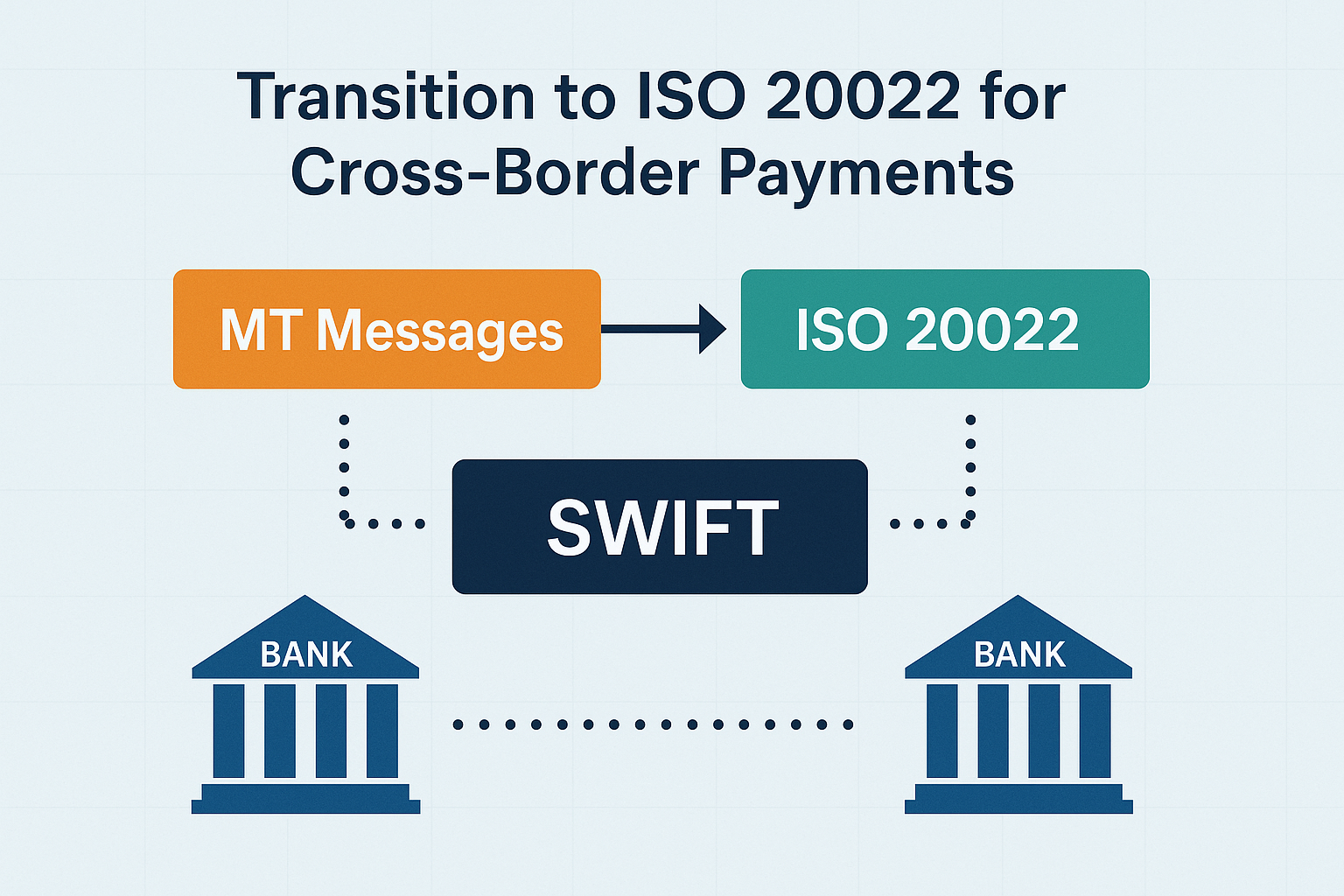
From 22 November 2025, the way banks send and receive international payment messages via SWIFT will change in a fundamental way.
SWIFT will stop using the old MT messages (such as MT103 and MT202) for most cross-border payments and move entirely to a newer, richer standard called ISO 20022 for those flows.
For international traders and trade clients, this is not just an IT upgrade in the background. It will influence:
- How your cross-border and USD payments are sent and received;
- How easily payments can be tracked, reconciled and matched to invoices;
- The quality of data banks will require about you, your counterparties and your underlying trade.
This article explains the change in practical terms and sets out what you should do to prepare.
1. What Is ISO 20022 in Simple Terms?
Think of ISO 20022 as a new global language for payment messages.
Under the old system, banks used MT messages with short, sometimes unstructured text fields.
Under ISO 20022, banks use messages with many more fields and structured data; separate boxes for names, addresses, IDs, purpose of payment, invoice references and so on.
For you, this means that when you send money abroad:
- You can attach much more precise information to each payment;
- The bank can pass that information through the system without truncation;
- The receiving party and their bank can see clearly what the payment relates to.
This standard is being adopted not only by SWIFT, but also by major domestic high-value payment systems, so that payments can carry rich data from end to end.
2. What Happens on 22 November 2025?
SWIFT has set 22 November 2025 as the end of the “co-existence period” for key cross-border payment and cash-management messages. From that date:
- Banks will no longer be allowed to send those payments in MT format over SWIFT;
- They must use ISO 20022 payment messages (called pacs. and camt. messages);
- SWIFT will not guarantee the integrity of data if banks try to stay on MT.
Some reporting messages will transition on a slightly different timetable, but for trade-related cross-border payments, ISO 20022 will be the standard.
You may not see this directly in your online banking platform, but your bank will change the underlying formats it uses. In many cases, your files, host-to-host connections or APIs will also be upgraded.
3. Why Should International Traders Care?
You might ask: “If the bank handles this, why does it matter to me?”
It matters because ISO 20022 changes the expectations around data quality and makes payments more traceable and transparent.
3.1 Richer Remittance Information
You will be able to include more detailed information, for example:
- Multiple invoice numbers and shipment references;
- Contract IDs, Incoterms and other trade references;
- Tax and customs details where required.
This supports:
- Faster and more accurate automatic reconciliation in your ERP/treasury systems;
- Fewer queries from counterparties asking “what is this payment for?”;
- Better alignment between payment flows and trade documentation.
3.2 Better Compliance, Less Friction (If Data Is Good)
Regulators want cross-border payments to be faster, cheaper, more transparent and more secure, and they see ISO 20022 as a key tool to achieve that.
Because the data is more structured:
- Banks can perform sanctions, AML and “know-your-customer” checks more effectively;
- They can see who is really paying whom and for what;
- Legitimate trade payments should, over time, experience fewer delays for unclear information, provided you supply complete and accurate details.
If your data is poor (for example, incomplete addresses, inconsistent names, vague payment references), you may find banks pushing back more aggressively.
4. What Does This Mean for USD Payments?
Many international trade transactions are denominated in USD, even when the buyer and seller are outside the United States.
Two key USD systems are now ISO 20022-based:
- CHIPS migrated to ISO 20022 in April 2024;
- Fedwire Funds Service completed its ISO 20022 migration on 14 July 2025.
Combined with SWIFT’s change in November 2025, this means that a USD payment can be:
- Created in an ISO 20022 format at your bank;
- Sent across borders via SWIFT using ISO 20022 CBPR+;
- Settled in the US using ISO 20022 in CHIPS or Fedwire;
- Received by the beneficiary bank with the full set of structured data intact.
For traders, this should reduce:
- Data loss between systems;
- Errors and manual investigations;
- Misunderstandings about which invoice or shipment has been paid.
5. Tracking Payments: From “Where Is My Money?” to Live Status
Most large banks now support SWIFT gpi (Global Payments Innovation). Each payment carries a
Unique End-to-End Transaction Reference (UETR), think of it as a tracking number for your payment.
With ISO 20022 and gpi combined:
- You (through your bank’s portal or channels) can see the real-time status of a payment, when it left,
which bank currently holds it, when it was credited.
- You can see fees deducted and FX margins along the chain.
- You can provide trading partners with evidence of payment quickly and with clear timestamps.
In a trade context, this is extremely useful for:
- Shipments tied to payment milestones (before loading, upon BL, upon delivery, etc.);
- Resolving disputes about “non-receipt” of funds;
- Demonstrating to counterparties and logistics providers that funds have been sent and where they are in the chain.
6. Does This Mean All Payments Move Onto Blockchain?
Short answer: NO.
There is a lot of commentary online suggesting that, after November 2025, all SWIFT payments will effectively be on blockchain, or that specific crypto coins will be used for all settlements. That is not supported by SWIFT or central-bank documentation.
The accurate position is:
- ISO 20022 is a messaging and data standard, not a blockchain;
- Some blockchain and digital-asset platforms are designed to map their data to ISO 20022, so they can more
easily interface with banks;
- SWIFT and some banks have run pilots that link bank systems to various blockchains for specific use cases,
but that is very different from moving all SWIFT traffic to public blockchains.
Over time, ISO 20022 makes it easier for banks and regulated platforms to connect to solutions such as:
- Central bank digital currencies (CBDCs);
- Tokenised deposits or tokenised trade assets;
- Regulated digital settlement platforms.
However, for the foreseeable future, most international trade payments, especially in USD, will continue to move through regulated banking rails, now using richer ISO 20022 messages.
7. Practical Implications for Cross-Border Trade
7.1 For Importers and Exporters
You can expect:
- Banks to request more structured information about counterparties (full legal names, correct addresses, IDs,
possibly LEIs);
- More emphasis on correctly completing purpose of payment and remittance fields;
- Better tools in your banking portals for payment tracking and downloading detailed payment reports.
In return, you should see:
- Fewer issues matching incoming funds to invoices;
- Less manual reconciliation work when you receive multiple payments from the same buyer;
- Improved visibility on where and why a payment is delayed.
7.2 For Trade Finance Structures
Whether you use:
- Documentary collections;
- Documentary credits (LCs);
- Open-account trade with bank guarantees or credit insurance;
ISO 20022 supports:
- Clearer linkage between payment messages and trade instruments
(for example, LC or guarantee references in structured fields);
- Better alignment of payment data with shipping, customs and logistics information;
- Enhanced ability for banks to monitor the underlying trade for risk and compliance,
which can be positive if your business is well-documented and compliant.
7.3 For Treasury and Back-Office Teams
Treasury and finance teams will want to:
- Ensure that ERP and treasury systems can capture and store UETR, which becomes the key reference for payment
tracking and investigations;
- Take advantage of richer payment reports to improve cash-flow forecasting;
- Revise internal processes around cut-off times, payment confirmations and communication with counterparties,
now that tracking and transparency are better.
8. What You Should Do Now
Even though your bank is responsible for implementing ISO 20022, international traders and trade clients should take active steps to prepare.
- Engage With Your Banks
Ask how they are implementing ISO 20022 and SWIFT gpi for your accounts. Confirm any changes to file formats, host-to-host connections or APIs you use to send payment instructions.
- Clean Up Counterparty Data
Verify that you have accurate and complete details for your suppliers, buyers and logistics partners (names, addresses, bank account details, BICs, etc.). Where relevant, capture LEIs or other identifiers used by your banks.
- Standardise References and Remittance Data
Adopt consistent rules for invoice numbers, contract IDs and shipment references. Ensure your staff know what information to put into payment references so that it maps correctly into ISO 20022 fields and supports reconciliation.
- Integrate UETR Into Your Processes
Work with your bank and IT teams to capture and store UETRs in your systems. Use UETR as the standard reference in internal
communication about payment status and in correspondence with counterparties.
- Update Policies and Training
Update internal payment policies and trade procedures to reflect new data requirements and tracking capabilities. Train finance and trade staff on how to use tracking tools and interpret richer payment reports.
9. Summary: What the New System Means for Cross-Border Trade and USD Payments
From 22 November 2025, cross-border payments sent via SWIFT will move fully onto the ISO 20022 standard
for the in-scope messages, replacing legacy MT formats.
For international traders and trade clients, this means:
- Richer, more structured data with each payment, including detailed remittance information tied directly
to trade documents;
- End-to-end tracking of payments via UETR and SWIFT gpi, with visibility of status, fees and timing across
all banks in the chain;
- Improved alignment of cross-border payment flows with domestic USD systems (CHIPS and Fedwire), which are also
ISO 20022-based, reducing data loss and reconciliation problems for USD trade flows.
The system does not magically move all payments onto public blockchains. Instead, it creates a more data-rich, transparent and programmable environment on existing regulated banking rails, and lays the groundwork for future integration with CBDCs and tokenised assets where regulators permit.
For well-organised traders (with clean master data, disciplined use of references, and good internal systems) this transition should be a net positive, offering better control over cash, stronger evidence of payment and fewer disputes. The main risk is for those who ignore it and continue to send poor-quality payment data into a system that is becoming less tolerant of ambiguity.
ISO 20022 & SWIFT 2025 Upgrade – Frequently Asked Questions
1. Does a recipient still request the sender to provide a SWIFT MT103? If not, what is the new proof of payment?
No. After November 2025, the MT103 is no longer used for cross-border customer credit transfers over SWIFT.
The ISO 20022 equivalent is the pacs.008 – FI to FI Customer Credit Transfer message, which now carries
the full payment data and the UETR (Unique End-to-End Transaction Reference).
In practice, banks do not usually give customers a raw pacs.008 message. Instead, the payee should request either:
- a SWIFT gpi payment confirmation, and/or
- the UETR, which can be used to track the payment end-to-end.
The UETR and gpi confirmation together now serve as the standard proof that funds have been transferred.
2. How do we refer to other SWIFT MT messages such as MT760 (SBLC) and MT700 (Documentary LC)? Are they also changing?
The mandatory ISO 20022 migration in November 2025 only applies to cross-border payments and cash-management messages (for example MT103, MT202 and related enquiry messages). Trade-finance messages such as:
- MT760 – Standby Letter of Credit / Guarantee issuance,
- MT767 – SBLC / Guarantee amendments,
- MT700 – Documentary Letter of Credit issuance,
- MT707 – LC amendments
remain in use for now and are still referred to by their MT numbers. SWIFT plans future ISO 20022 standards for trade finance, but until those are implemented, these MT messages continue to operate alongside the new ISO 20022 payment messages.
3. What should a payee or beneficiary do to ensure timely receipt of funds under ISO 20022?
Beneficiaries should focus on data quality. In particular, they should:
- Provide complete and accurate account details (full legal name, structured address, correct account/IBAN, correct BIC/SWIFT).
- Give the payer clear remittance information (invoice numbers, shipment references, purchase-order numbers, etc.) so it can be entered in structured ISO 20022 fields.
- Ask the payer to share the UETR once the payment has been sent, so the payment can be tracked in real time.
- Ensure that their bank holds up-to-date KYC and compliance documentation to avoid unnecessary holds.
ISO 20022 enables faster processing, but only if the information provided is complete and properly structured.
4. What replaces MT199 and MT299 free-format messages for payment-related enquiries?
Free-format MT199 and MT299 messages are being replaced by a range of structured ISO 20022 investigation and service messages, such as:
- camt.026 – responses to certain payment investigations and returns,
- camt.029 – resolution of investigations (status updates and outcomes),
- camt.060 – various payment status and reversal-related requests.
These messages provide structured data instead of unstructured text, which improves clarity and reduces delays.
5. How does the new ISO 20022 system improve traceability of international payments?
Traceability is significantly enhanced through the combination of ISO 20022 and SWIFT gpi:
- Every payment carries a UETR, recognised end-to-end across all banks in the chain.
- SWIFT gpi requires participating banks to update payment status in near real time.
- Senders and beneficiaries can see where the payment is, when each bank processed it and what fees were deducted.
This replaces the traditional model of manual investigations and “please wait 48 hours” responses.
6. Will payments be faster under ISO 20022?
In many cases, yes. ISO 20022 enables:
- Better automated sanctions and AML screening due to structured party data.
- Fewer manual repairs caused by truncated or unclear information.
- Closer alignment with ISO 20022-based RTGS systems such as CHIPS and Fedwire for USD flows.
While each bank retains its own cut-off times and risk controls, the overall industry trend is toward
faster, more predictable cross-border settlement.
7. Does ISO 20022 change the way USD cross-border payments move through the banking system?
Yes, it improves consistency and data quality. Both major USD high-value payment systems now use ISO 20022:
- CHIPS has migrated to ISO 20022.
- Fedwire Funds Service has also migrated to ISO 20022.
Combined with SWIFT’s ISO 20022 CBPR+ standard, this allows a USD payment to be ISO 20022-native from originator bank,
through the cross-border leg, into US settlement systems and on to the beneficiary bank.
This reduces format conversions, improves data integrity and simplifies reconciliation for USD trade payments.
8. Do importers and exporters need to upgrade their own internal systems?
While banks are responsible for the SWIFT migration itself, traders benefit greatly from improving their internal systems.
Best practice includes:
- Ensuring ERP and treasury systems can store and search by UETR.
- Standardising invoice, contract and shipment references so they can be embedded in structured remittance fields.
- Working with banking partners to adopt ISO 20022-friendly file formats or APIs for payment initiation and reporting.
Corporates that modernise their internal data structures typically see fewer reconciliation issues and faster resolution of payment queries.
9. Will banks still accept free-format payment descriptions?
Some banks may still accept unstructured descriptions, but doing so undermines the benefits of ISO 20022 and can increase the risk of delays.
The new standard strongly favours:
- Structured party names and addresses,
- Clear purpose-of-payment codes,
- Structured remittance information (for example dedicated fields for invoice and contract references).
The more structured and precise the data, the less likely a payment is to be delayed for compliance reasons or manual review.
10. Does ISO 20022 affect how fund transfers are used as evidence of payment in trade contracts?
Yes. Under the MT regime, many contracts referred to a “copy of the MT103” as evidence of payment.
Under ISO 20022, the functional equivalent is:
- the UETR, and
- a SWIFT gpi payment confirmation or tracking report showing that the payment has been credited to the beneficiary bank.
Going forward, it is sensible for trade contracts to refer to “proof of payment by means of SWIFT gpi confirmation and/or UETR-based tracking report” rather than specifically referencing an MT103. This aligns contractual language with the new ISO 20022 environment.
Disclaimer
This document is provided for general informational purposes only and does not constitute financial, legal, or professional advice. While care has been taken to ensure accuracy, no warranty is given as to the completeness or reliability of the information contained herein. Readers should seek independent advice before acting upon any information provided.