

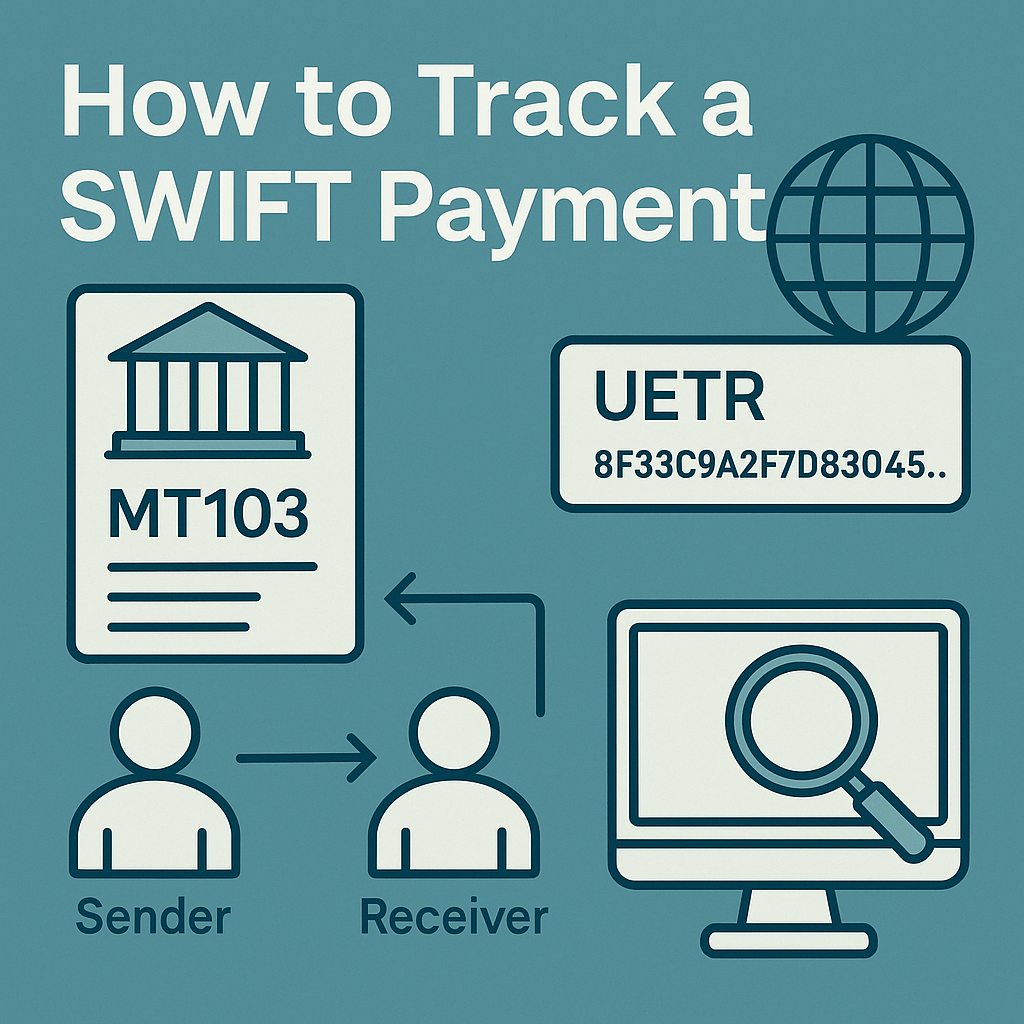
How to Track SWIFT Payments A Complete Guide to MT103, UETR, and USD Cross-Border Transfers

International payments can pass through multiple intermediary banks, compliance filters, and settlement systems. When money appears β€œstuck in transit”, knowing how to trace, validate, and evidence its path is essential.This guide explains in professional and legal detail how to track SWIFT payments, interpret an MT103 message, leverage the UETR (Unique End-to-End Transaction Reference), and understand additional mechanisms for enhanced traceability. It also covers key considerations for USD-denominated transfers, and provides official resources for verifying account and routing details.

1. Understanding the MT103: The Primary Proof of Payment

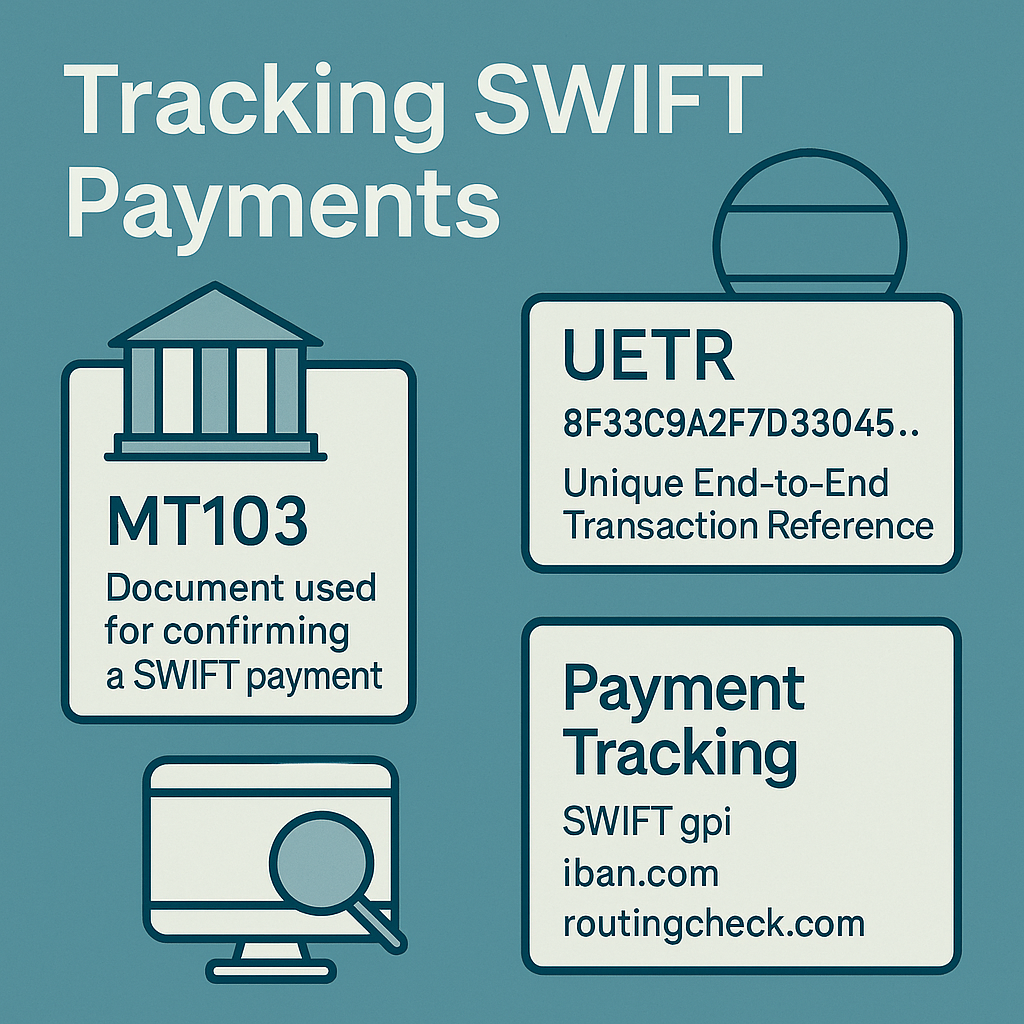
An MT103 is the formal SWIFT message type used for a single customer credit transfer. It serves as the payment’s DNA record, showing the sender, receiver, intermediaries, amount, currency, and value date.

It includes critical fields such as:

  • :20: Sender’s reference
  • :32A: Value date / currency / amount
  • :50K: Ordering customer
  • :56A, :57A: Intermediary and beneficiary banks
  • :59: Beneficiary name and account (IBAN)
  • :71A/G: Charges (OUR/SHA/BEN)

The MT103 is legally accepted evidence of transmission and is typically required to open an investigation or satisfy a commercial obligation that payment was made.

2. The UETR – Your Global Tracking ID

The UETR (Unique End-to-End Transaction Reference) is a 36-character identifier attached to every SWIFT payment. It functions like a courier tracking number, enabling all banks in the chain to see the transaction’s current status through the SWIFT gpi Tracker.

Statuses visible through UETR include:

  • ACSP – Accepted for processing
  • RJCT – Rejected
  • PDNG – Pending (often compliance hold)
  • ACSC – Accepted, settlement completed

Having the UETR allows your bank (and sometimes you) to retrieve real-time updates: whether the payment is received, credited, on hold, or returned.

3. Advanced Methods for Tracking and Verification

Beyond the MT103 and UETR, several other professional tools and mechanisms assist in tracing payments:

  • MT202 COV and the β€œCover Payment” Path: For complete traceability, request both the MT103 and MT202 COV if available.
  • SWIFT gpi Basic Tracker & Bank Portals: The SWIFT Basic Tracker and many major banks (e.g., Deutsche Bank, Standard Chartered, HSBC) provide portals or APIs to view payment status.Examples:
    Deutsche Bank – International Payment Tracker,
    Commonwealth Bank – Track International Transfers.
  • Pre-Validation Services: Before executing a transfer, some banks offer pre-validation APIs to check the accuracy of beneficiary account details.
  • Stop & Recall / Payment Amendment: SWIFT gpi banks may offer β€œStop & Recall” functionality for payment reversal before final credit.
  • Automation & API Integration: Corporate clients can integrate UETR feeds into their treasury systems for automatic monitoring.

4. Cross-Border Risks and USD-Specific Considerations

When a transaction involves USD, extra complexity arises because almost all USD clearing is performed via US-based correspondent banks.

  • U.S. Correspondent Chain: Your bank may use an intermediary bank in New York, identified in MT103 fields :56A or :57A.
  • OFAC and Sanctions Screening: USD transactions pass through the U.S. system and are subject to OFAC compliance.
  • Fees and Charge Methods: Always specify OUR, SHA, or BEN. For commercial settlements, use OUR to ensure full credit.
  • Time-Zone and Cut-Off Misalignment: Consider U.S.–Your Country time differences to avoid value date delays.
  • FX Conversion and Dual-Currency Posting: Clarify when conversion occurs and which rate applies.
  • Compliance Documentation: Banks may request source-of-funds or invoices for compliance clearance.

5. Verification of Account and Routing Details

Before any transfer, verify that account identifiers are structurally correct and correspond to the right financial institution.

TypeTool / Official RegistryLink
IBANSWIFT IBAN Registryswift.com/iban-registry
IBANSWIFTRef IBAN Validationswift.com/iban-validation
BIC/SWIFT CodeSWIFT Free BIC Searchswift.com/bsl-free
U.S. Routing NumberFederal Reserve E-Payments Directoryfrbservices.org/EPaymentsDirectory
Australia BSBAusPayNet BSB Searchauspaynet.com.au/resources/bsb
General ValidatorIBAN.com (Non-official but widely used)iban.com/iban-checker

6. Typical Statuses When Tracking via UETR

CodeDescriptionMeaning
ACSPAccepted for executionPayment is processing normally
PDNGPendingAwaiting compliance clearance
RJCTRejectedPayment returned or failed
ACSCAccepted – Settlement CompletedBeneficiary bank credited
CANCCancelledPayment recalled or stopped

7. Legal and Compliance Observations

The MT103 is strong evidence of payment dispatch but not proof of credit; rely on the UETR final confirmation for proof of receipt. Contracts should define β€œpayment received” as the time at which the beneficiary’s bank confirms credit, not merely when funds leave the sender’s bank.

For regulated industries or high-value trades, keep a full audit trail: MT103, UETR log, and bank correspondence confirming receipt. Be alert to false proofs of payment (forged MT103s); always verify authenticity through your bank using the UETR or a call-back confirmation.

8. Authoritative Resources for Further Reference

Appendix: Cross-Border Payment Tracking Checklist

For Senders
  • Validate IBAN, BIC, and intermediary details.
  • Request UETR and MT103 upon initiation.
  • Monitor status using SWIFT Tracker or bank portal.
  • Confirm final credit and fees.
  • Retain MT103, UETR, and confirmation records.
For Receivers
  • Provide accurate beneficiary account and BIC details.
  • Request MT103 and UETR from sender.
  • Use your bank to confirm receipt or run a trace.
  • Respond promptly to compliance requests.
Common Pitfalls to Avoid
  • Assuming MT103 equals cleared funds.
  • Ignoring intermediary deductions.
  • Failing to specify OUR charges.
  • Missing cut-off times between jurisdictions.

Disclaimer

This document is provided for general informational purposes only and does not constitute financial, legal, or professional advice. While care has been taken to ensure accuracy, no warranty is given as to the completeness or reliability of the information contained herein. Readers should seek independent advice before acting upon any information provided.
We use cookies to give you the best online experience. By agreeing you accept the use of cookies in accordance with our cookie policy.

Close Popup